VSTTeams Edition · Multi-view Incident

Multi-view incident · interactive walkthrough

Bodycam, phone, CCTV — one incident you can search.

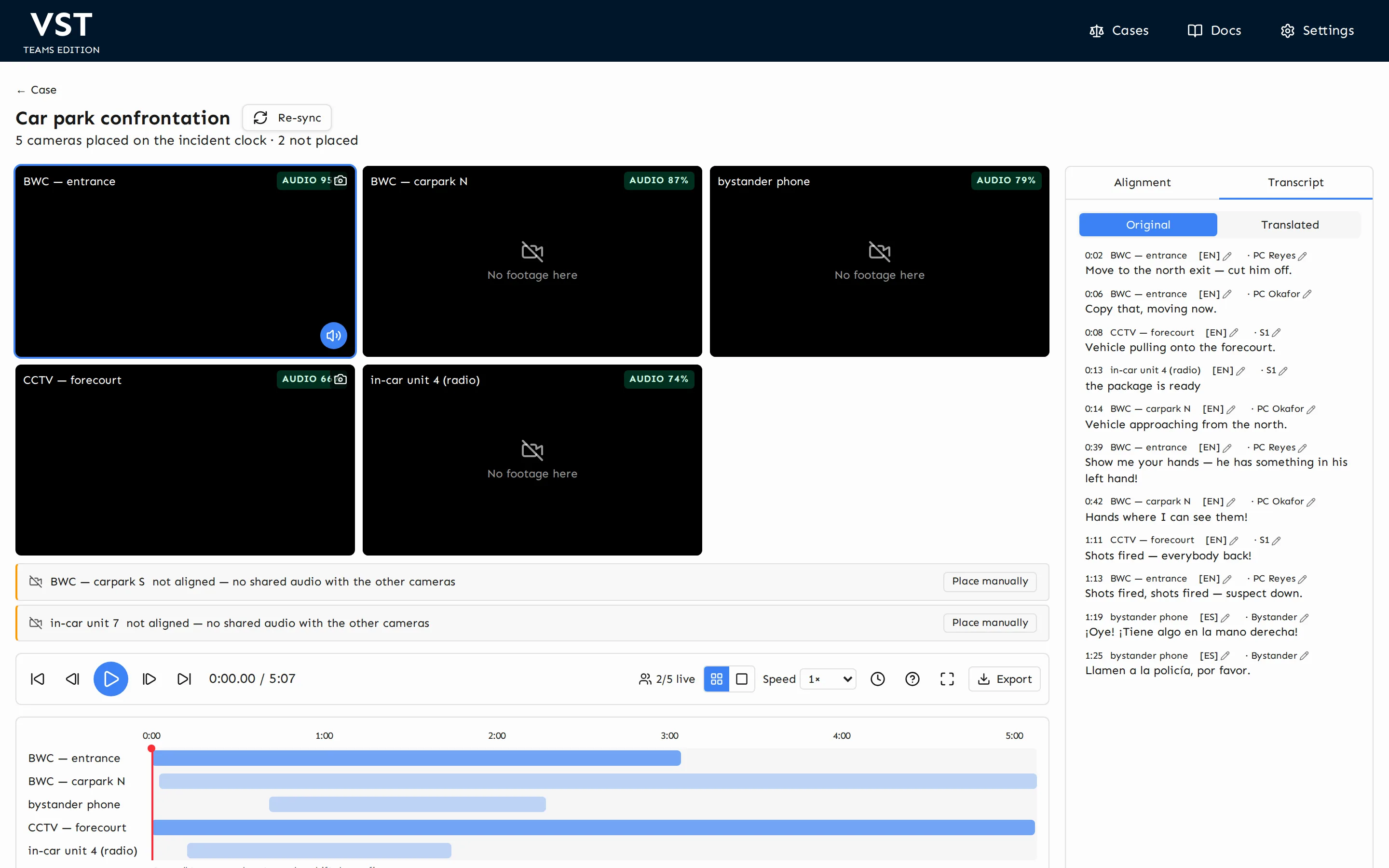
An incident arrives as hours of overlapping recordings from cameras that never agree on the time — body-worn, a bystander's phone, forecourt CCTV, an in-car radio. VST lines them up from their own audio onto a single incident clock — frame-accurate where they share sound, placed by hand where they don't — transcribes and translates every one, and keeps each on infrastructure your organisation controls. What was hours of footage becomes one account you can read, search, and check against the source.

Begin the tour → Canned click-through of the real screens, on a synthetic incident. Nothing here is processed.
The workflow, in four steps
Sync

Every camera on one clock — precisely, and by hand where needed

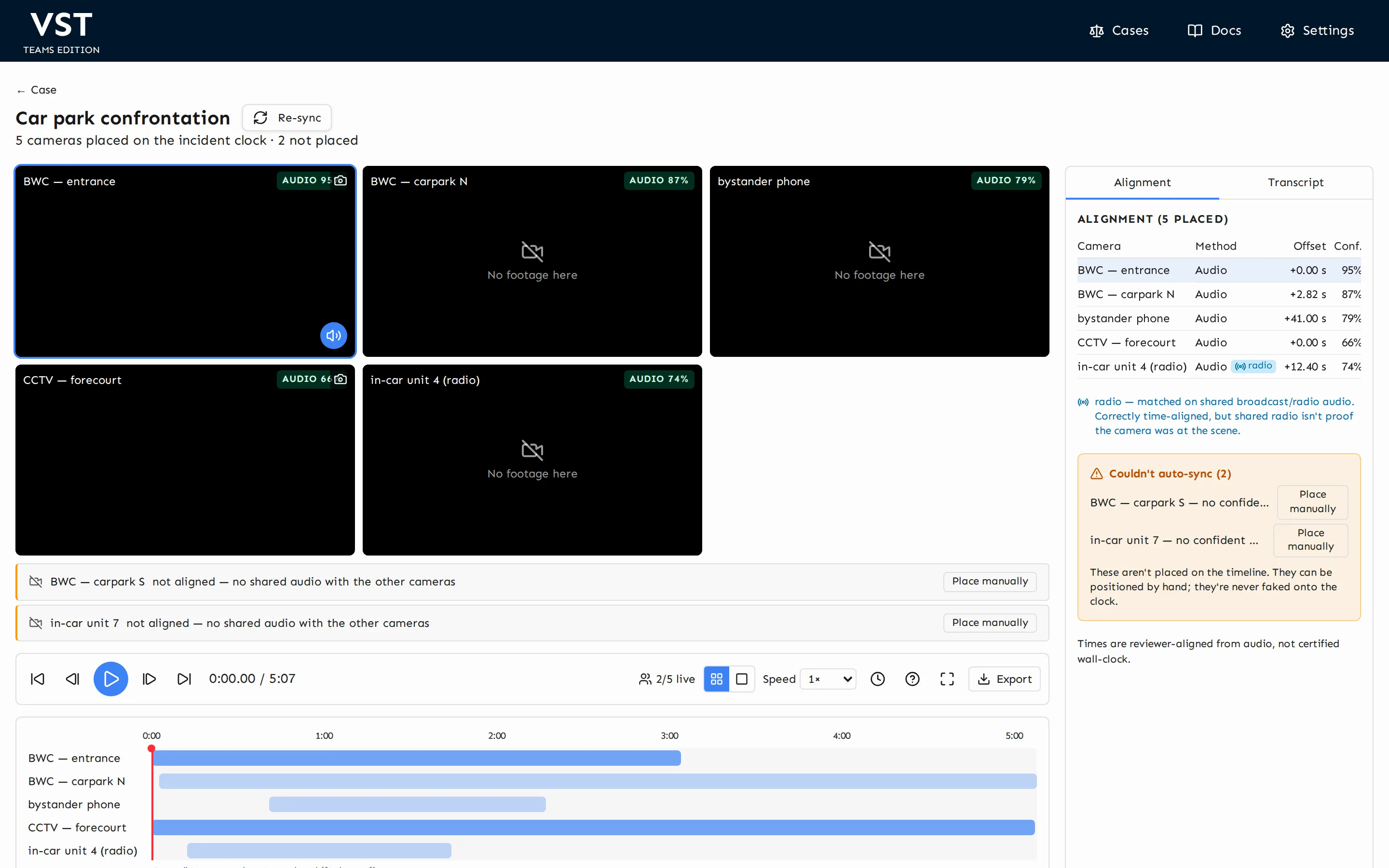
VST aligns the cameras from their own audio onto a single incident clock — here five of seven: body-worn, a bystander's phone, forecourt CCTV, an in-car radio. Where cameras share sound the audio match is frame-accurate, each placement carrying its confidence, with a radio match flagged as time-only — correctly aligned, but not proof the camera was at the scene. A camera with no shared audio — a silent CCTV feed, a distant angle — isn't guessed onto the clock: you place it by hand against a shared reference, and it's marked as reviewer-set.

The audio matcher is precise where cameras share sound and honest where they don't. Two feeds here have no shared audio, so they're set aside for a reviewer to place by hand — never faked onto the timeline.
Transcript

One searchable transcript across every camera

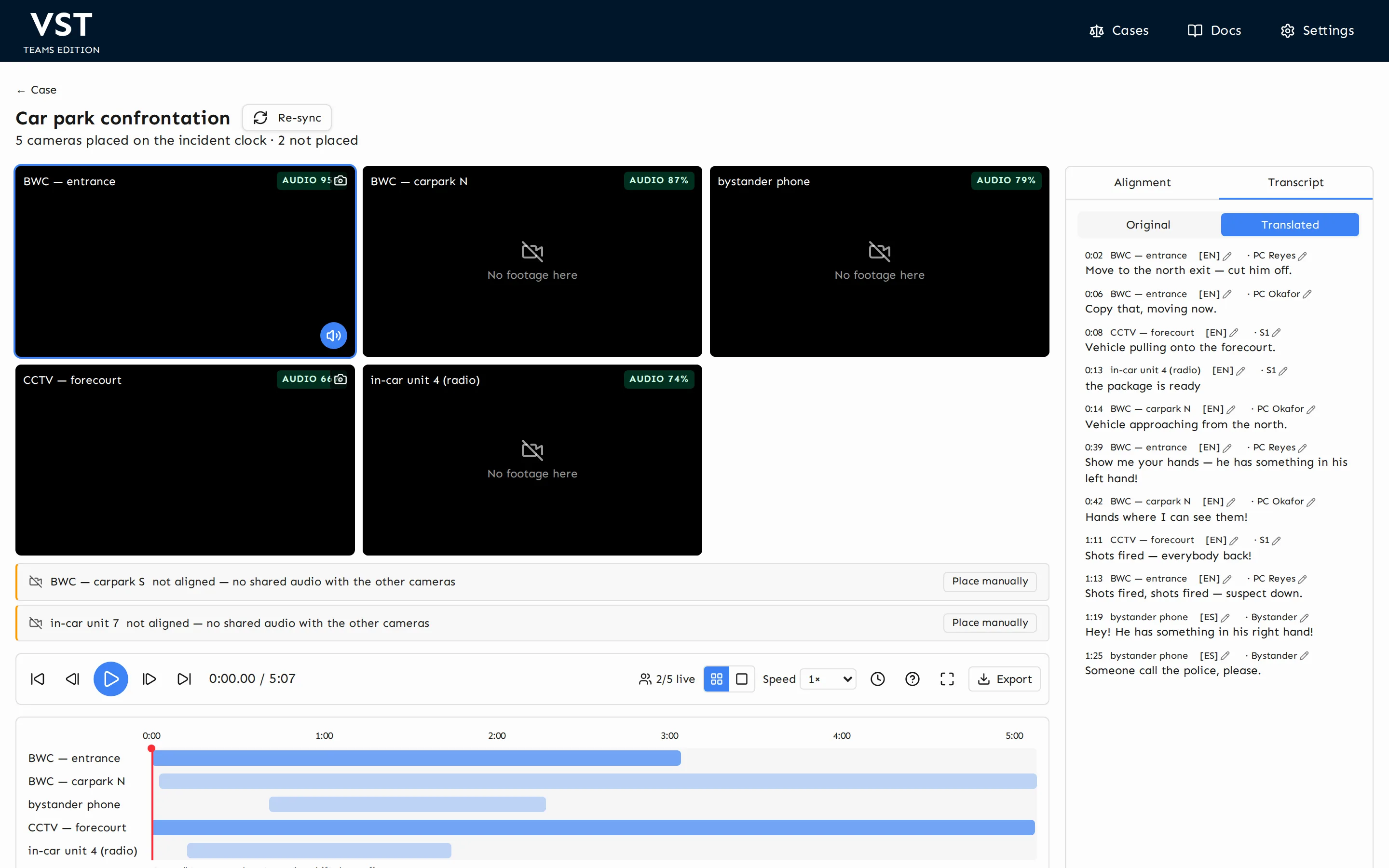
Every camera is transcribed and the lines merge onto the incident clock — each tagged with its camera, language and speaker — so the account reads in order regardless of which camera caught it. It also surfaces what a single feed would hide: at 0:39 the entrance body-cam reports the weapon in the subject's left hand; at 1:19 the bystander's phone says right hand. A contradiction you find by reading one timeline, not by scrubbing six.

Click any line to jump to that moment on the shared clock. Speakers can be renamed in place, and the diarised labels travel into the export audit.

Languages

Two languages, side by side

The bystander filmed in Spanish. VST detects the source language, keeps the Original, and produces a working Translated view in the reviewer's language — a toggle away. A defense reviewer reads the account without waiting on certified translation to know what's there. Where formal use needs a certified translation, the tool says so.

Detection is imperfect and named as such — a reviewer can correct a camera's source language and re-transcribe just that feed in the right one.

Export

Hand it over as a package you can defend

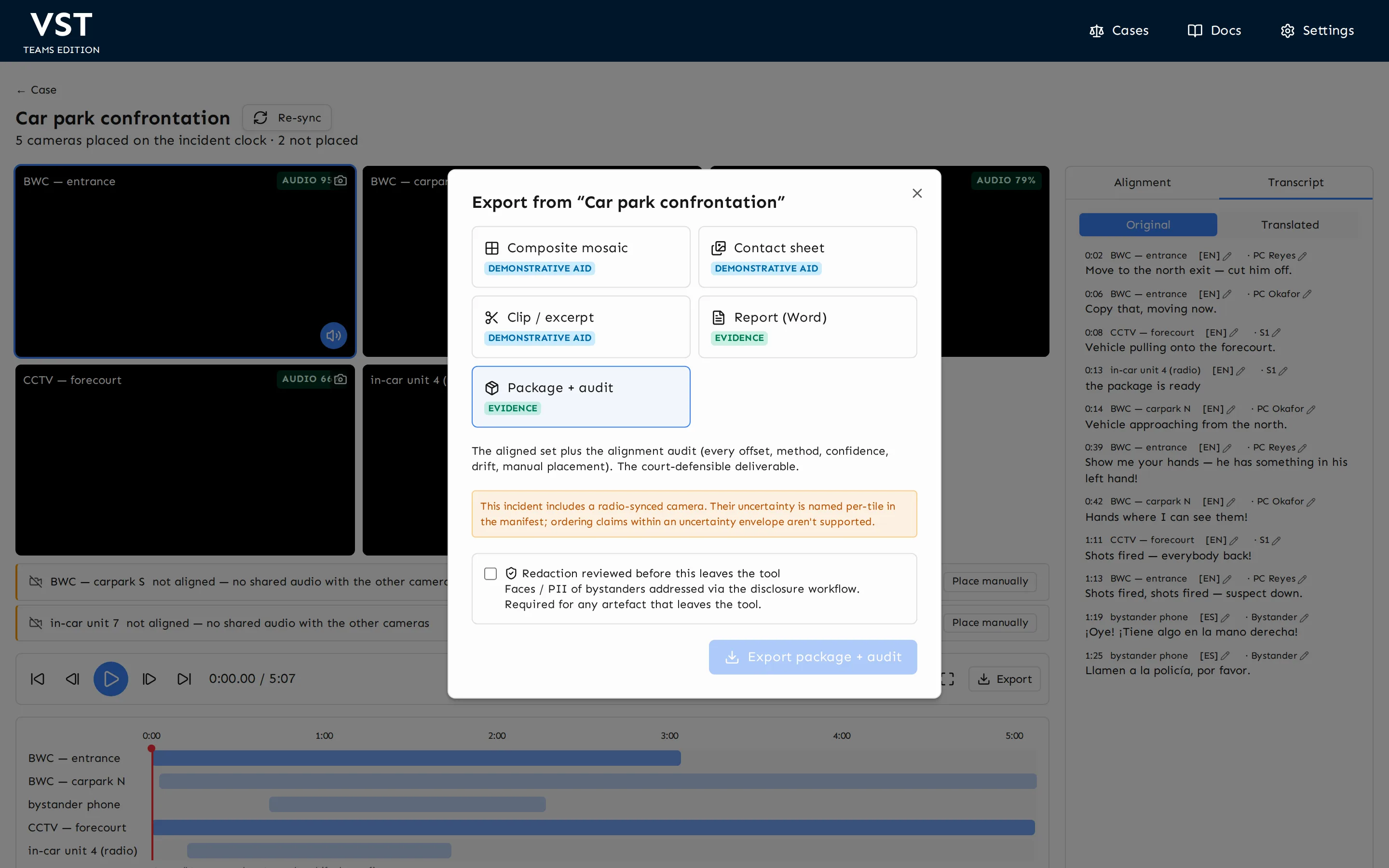
Export the aligned set as a composite video, a contact sheet, a marked clip, a Word report, or the full package + audit — every offset, method, confidence and manual placement recorded. A redaction-review gate is enforced before anything leaves the tool, and the times are stamped reviewer-aligned, never certified wall-clock.

The uncertainty is named per-tile in the manifest and a verification code ties any copy back to it. Ordering claims within an uncertainty envelope aren't supported — and the tool says so.

vst · Incident · alignment
⤢ ExpandEvery camera on one clock — precisely, and by hand where neededOne searchable transcript across every cameraTwo languages, side by sideHand it over as a package you can defend

Use to move · click a phase to jump
The footage stays with your organisation
VST runs on a workstation your organisation controls. Video, transcripts, translations and summaries stay on infrastructure you own — no mandatory upload to a shared AI service. See bodycam transcription for criminal defense.
Honest about what it can't do
Cameras that don't share sound are named and set aside, not guessed onto the clock. Transcripts are working transcripts for review, not certified; machine translation is triage, not a certified translation. The tool tells you where its limits are.
The civilian angle counts
Body-worn is only part of an incident. A bystander's phone, forecourt CCTV and a dashcam line up on the same clock as the police cameras — the footage a system that only syncs its own cameras leaves out.
A record you can check
Every summary and placement is linked back to the source recording, and the export audit records every offset, method, confidence and manual placement. The reviewer decides what it means; VST makes the evidence faster to navigate.