
Facial age estimation
Estimate apparent age from a face, with uncertainty alongside the result.
Try an image
Take a photo or upload an image to see age estimation in action.
Images you submit are kept for up to 7 days for trust & safety review, then deleted. Do not upload images of identifiable people without their consent. How we handle demo data →
Just curious how old you look? Play ageguesser.ai →
Overview
Use age estimates to prioritise investigative review or route age-ambiguous content for trust and safety teams. A visual estimate does not establish a person’s legal age.
For content-review workflows, see how trust and safety teams use apparent-age estimates alongside other signals. See the Trust & Safety solution page →
Evidence at scale
Age estimation enables investigators to rapidly characterise large volumes of seized material. The chart below shows the estimated age distribution across 100,000 faces detected in child sexual abuse material — illustrating how the capability can summarise large evidence sets for investigation and court presentation.
From a VST Teams run across 100,000 faces in seized CSAM.
Model performance
The current model (v3) is a vision transformer fine-tuned on a large, curated dataset of real-world images with verified age labels. It produces a point estimate along with a calibrated uncertainty value for each detected face.
These figures describe our benchmark dataset, not the accuracy of every upload. Error varies by age group, image quality and population; compare the age bands below.
Accuracy by age range
| Age range | MAE (years) | Within ±1 year | Within ±2 years |
|---|---|---|---|
| 0–2 | 0.41 | 95.3% | 97.7% |
| 2–5 | 0.72 | 88.3% | 97.0% |
| 5–8 | 0.77 | 86.1% | 96.4% |
| 8–13 | 1.06 | 73.6% | 93.1% |
| 13–18 | 1.26 | 69.9% | 85.0% |
| 0–18 (all minors) | 0.87 | 81.9% | 94.1% |
| 18–26 | 2.11 | 53.9% | 71.7% |
| 26–40 | 3.30 | 36.8% | 52.7% |
| 40+ | 5.04 | 22.4% | 34.2% |
Competitive performance
Independent evaluation against leading commercial age estimation systems shows that Rigr AI outperforms competitors at every single age from 0 to 16, with particularly strong advantages for younger children (ages 0–5) and the pre-teen/early-teen range (ages 8–15) where competitor error rates are 2–3× higher.
Calibrated uncertainty
On the evaluation dataset, 68.48% of true ages fell within the reported ±1σ interval, compared with 68.27% expected. This measures calibration on that dataset; it is not a guarantee for an individual image or another population.
Apparent-age and developmental-stage outputs are visual estimates. They do not verify identity or establish a person's legal age. High-risk and borderline decisions should include appropriate human review.
Operational use
Within VST Teams, Age Estimation is used to:
- Highlight potentially sensitive content involving minors
- Prioritise review across large media datasets
- Support evidential assessment without replacing human judgement
The capability is also available as a standalone API or lightweight application that can be deployed in an air-gapped environment. Plug-ins are available for major forensic image analysis tools.
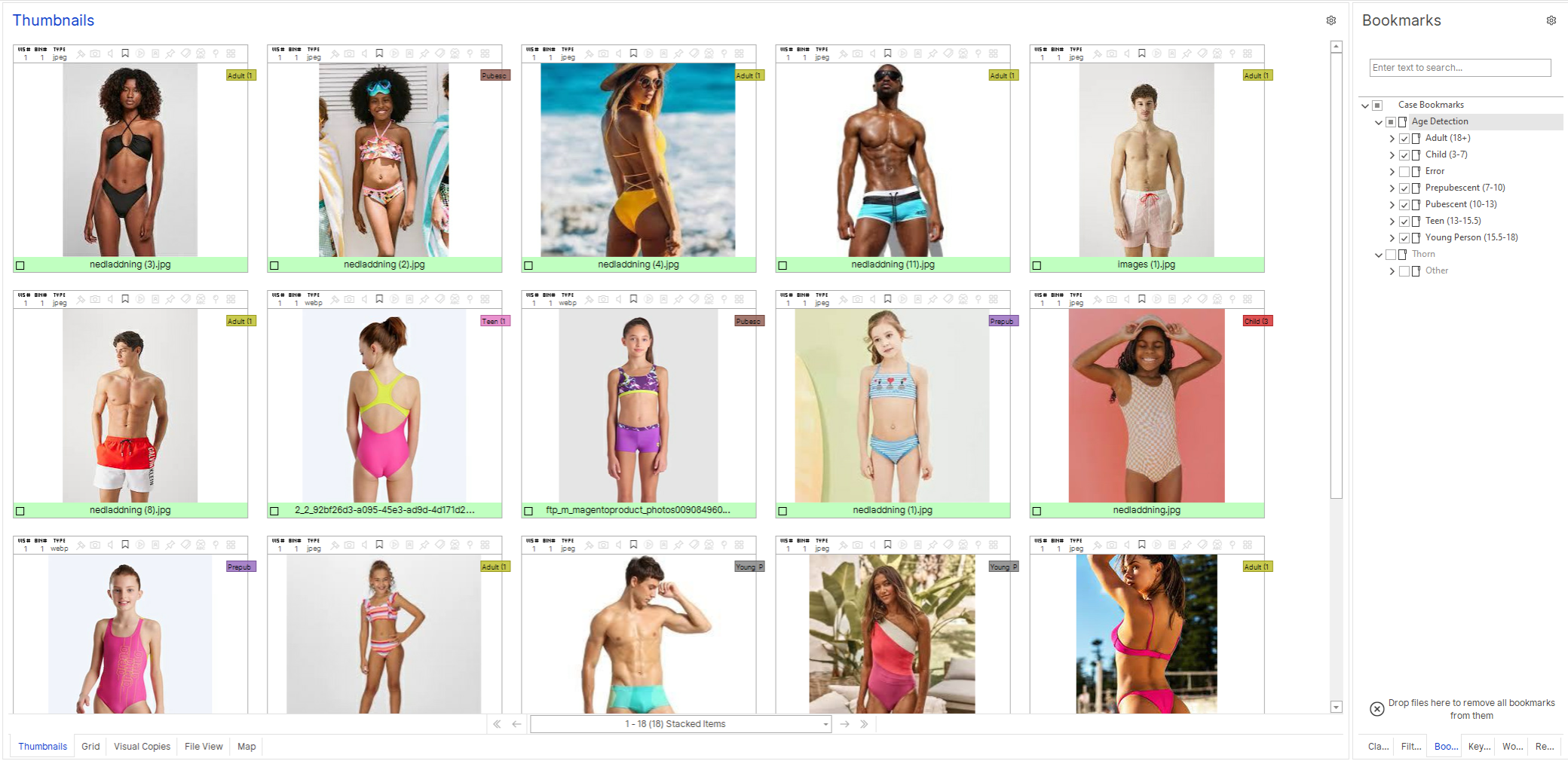
Integration with Griffeye
Age estimation results surface directly inside Griffeye Analyze, letting investigators filter and prioritise without leaving their existing workflow.
On-premise deployment
The on-premise options below keep processing within your infrastructure. This public demo is different: submitted images are retained for up to seven days for trust and safety review, then deleted. Demo data policy →
- Fully containerised
- On-premise and air-gapped operation
- No images sent to Rigr AI in an on-premise deployment
- Customer retains full control of inputs and outputs
For developers
The Media Examiner API accepts images as a multipart upload and returns estimated ages, bounding boxes, confidence scores, and calibrated uncertainty for every detected face.
Facial age estimation is integrated into Media Examiner. Where a suitable face is visible, the same request that returns nudity, anatomy and sexual-content detections also returns an apparent age and its calibrated uncertainty — you do not need to submit the image twice. Integrations built against the standalone age service continue to be supported.
Full endpoint, response-schema and error-code detail is in the Age Estimation API reference.
POST /classify curl -X POST https://api.mes.rigr.ai/classify \
-H "X-API-KEY: $API_KEY" \
-F "[email protected]" \
-F "model=VisualyzeV2" \
-F "estimate_age=true"{
"classification": {
"key": "rigr-none",
"display_name": "No sexual content",
"severity": 0
},
"flags": [],
"detections": [{
"class_name": "Adult Female Face",
"score": 0.9998,
"bbox": {"x": 0.31, "y": 0.12, "w": 0.18, "h": 0.24},
"age": 25.3,
"age_uncertainty": 1.2
}]
}Independent evaluation
Rigr AI took part in the Australian Age Assurance Technology Trial (2025) — an independent evaluation commissioned by the Australian Government and conducted by the Age Check Certification Scheme, which tested participants against a dataset the trial built rather than against each vendor's own benchmark.
Its assessment found Rigr AI strong on technical readiness, privacy alignment and usability, delivering reliable threshold-based age decisions with fast on-device processing and low false-positive rates in real-world scenarios. It noted the privacy-centric design — no personal data stored, biometric inputs processed and deleted locally in milliseconds after estimation — and the configurable buffer zones that let a relying party manage uncertainty rather than depend on a single hard threshold. The individual test report and participant interview are published on the trial's site.
Mean-absolute-error figures are not comparable between evaluations run on different datasets. Our own benchmark figures and any result measured on the trial's dataset are different tests, and a lower number on an easier set is not a better model.
Integrating it yourself?
The full Age Estimation API reference covers every endpoint, the request and response schemas, error codes, image limits and self-hosted Docker deployment — or get a free API key and start calling it. For review-routing workflows on a platform, see Trust & Safety age estimation.
Frequently asked questions
How accurate is Rigr AI's age estimation?
On our benchmark dataset, the current model achieves a mean absolute error of 1.64 years overall and 0.87 years for ages 0–18, with 68.9% of estimates within one year of the true age. Error varies by age, image quality and population; these figures do not guarantee the accuracy of an individual image. Each estimate carries calibrated uncertainty.
Can age estimation run on-premise or air-gapped?
Yes. It is fully containerised and can run on-premise or air-gapped, with no images sent to Rigr AI; inputs and outputs remain under your control. The public website demo is separate: it keeps submitted images for up to seven days for trust and safety review, then deletes them.
How does it scale to a full case?
Within VST Teams, Age Estimation runs across thousands of files in a case and returns the age distribution, the identified minors, and a priority queue. It is also available as a standalone API or lightweight application.
Does it replace human judgement?
No. It supports triage and evidential assessment; a calibrated uncertainty accompanies every estimate so reviewers retain final judgement.
Has it been independently evaluated?
Yes. Rigr AI took part in the Australian Age Assurance Technology Trial (2025), an independent evaluation commissioned by the Australian Government and run by the Age Check Certification Scheme against a dataset the trial built. Its assessment found Rigr strong on technical readiness, privacy alignment and usability, with reliable threshold-based decisions, fast on-device processing and low false-positive rates in real-world scenarios. The individual test report is published on the trial's site.